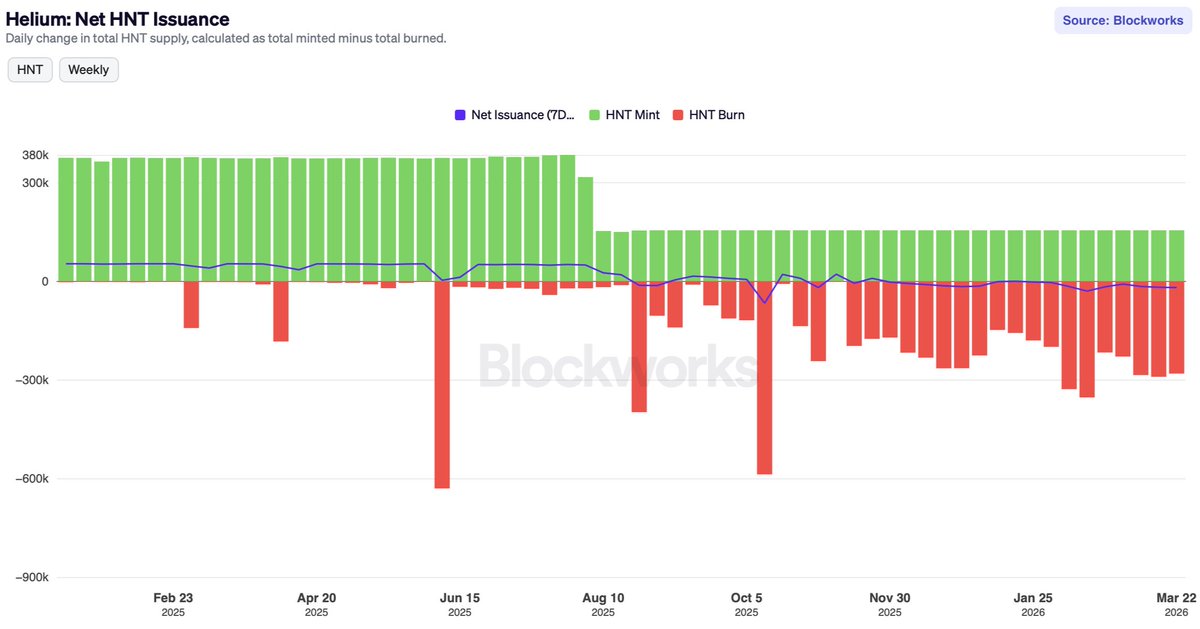
Helium got a lot of attention for becoming deflationary last month as a result of ongoing Mobile Data Transfer by Carrier growth.
While this alone is impressive, I found the valuation implications of the underlying tokenomic equilibrium even more interesting.
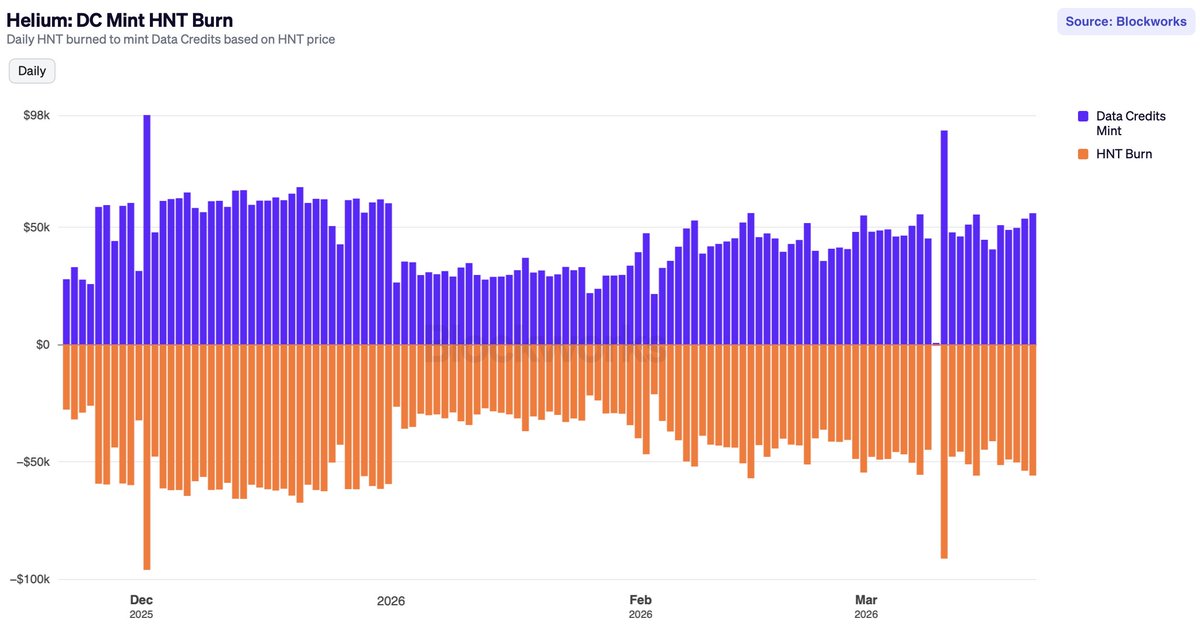
Helium users mint Data Credits (DC), where 1 GB of data = 50,000 DC.
Users mint these DC by burning $HNT.
The price of each DC is fixed at $0.00001.
Thus, Helium’s pricing is fixed in fiat, but burns variable $HNT based on current price.
Due to the recent market downturn, Helium’s market cap crossed a key level, where the variable amount of $HNT burned exceeds the amount minted.
While Helium has indeed traded at this price before, this time is different.
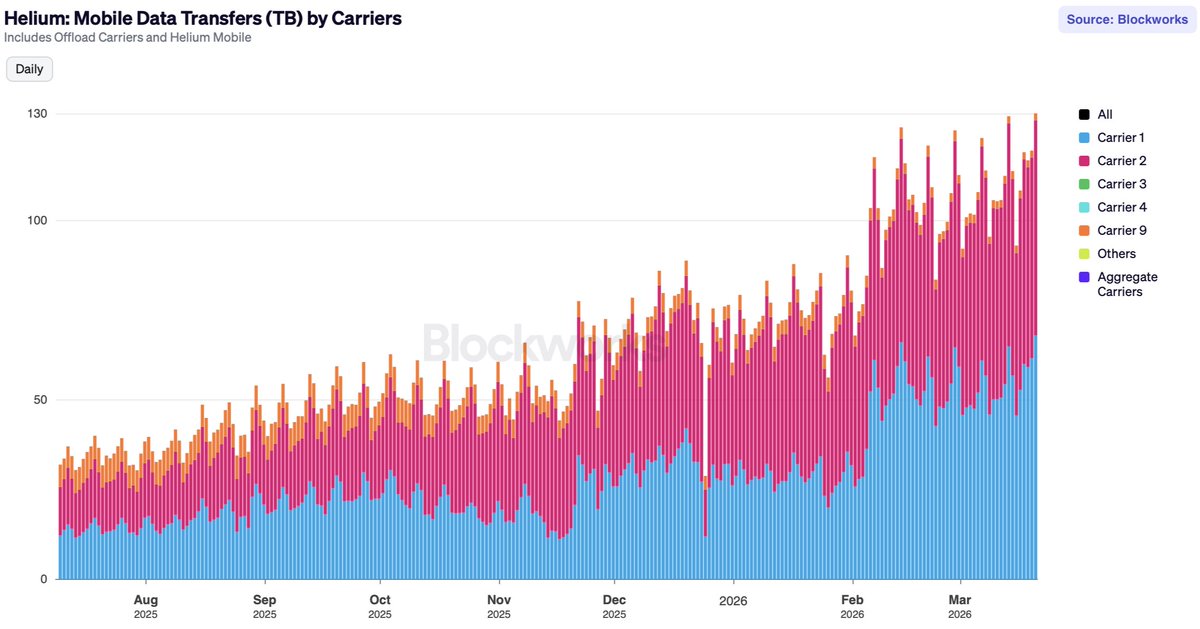
Since July, major carriers began offloading data to the Helium network, who’ve since grown the network’s usage by over 300%.
In August 2025, Helium underwent its third halving, reducing daily emissions from ~41,096 $HNT to ~20,548 $HNT. The next halving is August 1, 2027.
The combination of:
- Exceptional growth in Carrier Mobile Data Transfers
- 50% reduction in daily emissions due to the most recent halving
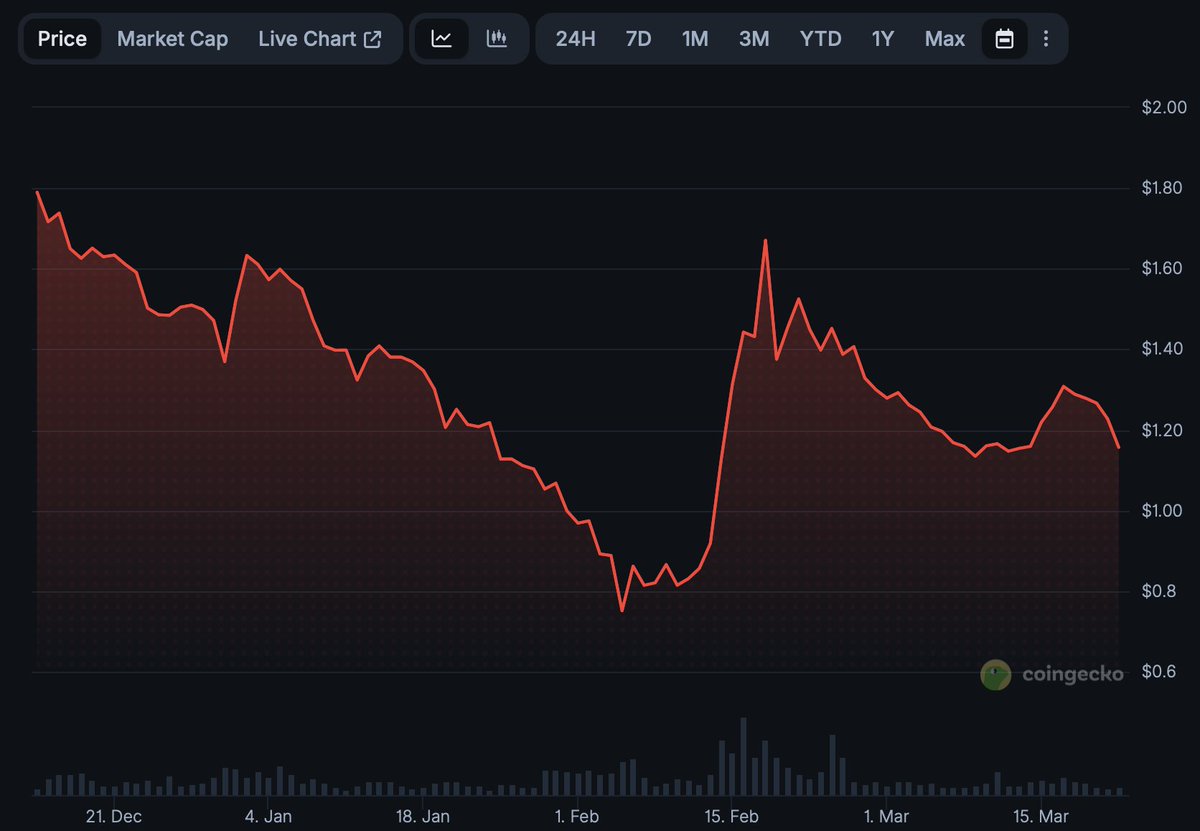
- Market downturn lowering market cap
has pushed $HNT into Burn and Mint Equilibrium (BME).
If you strip out speculation, the BME models the price of $HNT as a function of what the network burns in utility, with reflexivity in both directions, whereby valuation above said equilibrium suppresses burns (fewer $HNT burned per TB), undervaluation amplifies them.
There is some nuance on the lower timeframe here due to smoothening of HIP-20 but the premise generally stands. Overshoot to the downside? Deflation rate rises til price recovers. Outperform to the upside? Inflation rates go up pushing price back down.
This is exactly what happened mid February as deflationary headlines fueled a price rally of over 100%, reigning in inflation by ~75% in the same period.
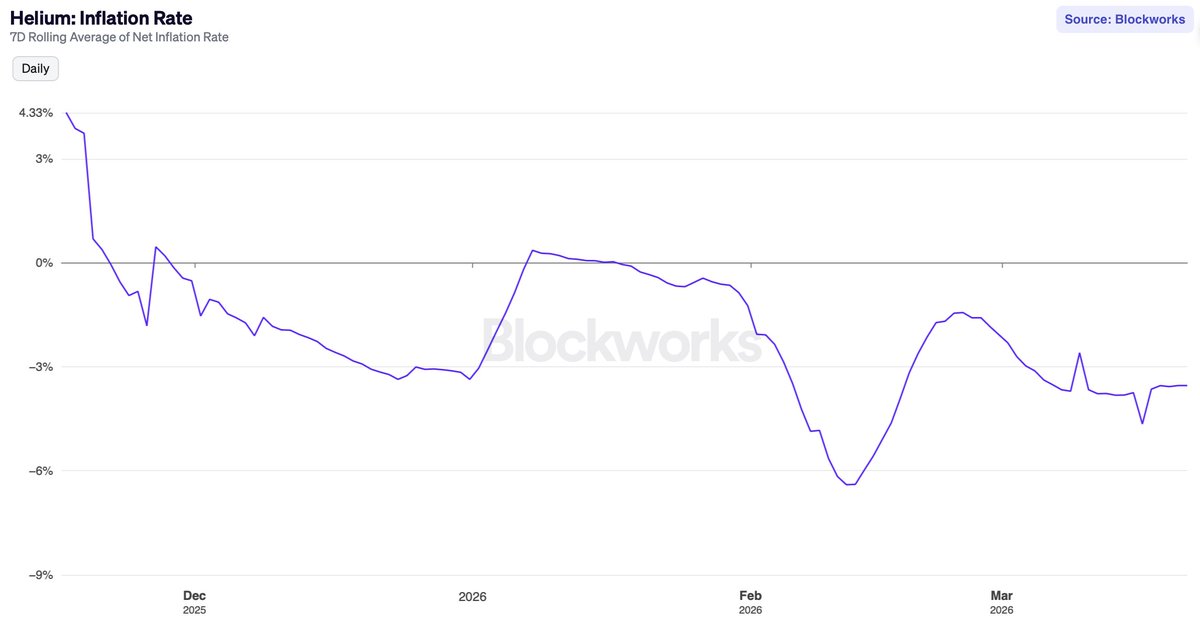
I should note, it is possible for the market cap to grow while still being inflationary, as it has many times in past. The BME at t0 forgoes any premium in periods t+1 and beyond.
That said, demand beyond the BME can be attributed to speculation of future growth in Mobile Data Transfers, rather than present day fundamentals. The key takeaway here is parsing through speculation and gaining a reference point to fundamentally driven price.
Beyond one of the only proven use cases in DePIN, Helium and its tokenomics create a clear link between utility and price, enabling valuation frameworks deeply rooted in fundamentals.
This analysis is part of @cybercapital 's ongoing DePIN research (views are my own). Credits to @blockworks and special thanks to @smyyguy for clean data and tables that make this possible. And thanks to @helium for proving my formerly bearish stance on DePIN wrong.